Thursday, September 26, 2013

The VFL/AFL Grand Final: A Pictorial History

This Saturday is Grand Final day, the biggest date in an overcrowded local sporting calendar. This event has a rich history, stretching back to the second VFL season in 1898, when Fitzroy (5.8.38) defeated Essendon (3.5.23) in front of 16 000 at the St Kilda Cricket Ground.

The following is a brief pictorial history, across these years...


1909

South Melbourne players march onto the MCG.


1910

Collingwood and Carlton play in front of a huge crowd.


1928

Collingwood Grand Final side.


1930


Geelong v Collingwood.


1933

Nash Diggins of South Melbourne gets a kick away.


1947

Grand Final Footy Record, Carlton v Essendon.


1956

A crowd of 115 000 spills out onto the MCG. Neil 'Hassa' Mann and Ian Ridley 
clash, Melbourne v Collingwood.


1961

The beginning of a long period of dominance; Hawthorn v Footscray.


1963

From the cheap seats; Geelong v Hawthorn.


1966

St Kilda captain Darrel Baldock celebrates the Saints only Grand Final 
win to date, a one point victory over Collingwood. Baldock was 
photographed wearing a Collingwood guernsey, having swapped with 
his opponent after the final siren.


1967

Richmond centre half forward Royce Hart.


1970

Merchandise stand, outside entrance 6. Please note
that no change will be given at the turnstiles.


Jesaulenko you beauty!

A still record crowd for any AFL/VFL match.


1971

Hawthorn full forward Peter Hudson worse for wear at half time after a clash 
with St Kilda hard man Kevin 'Cowboy' Neale.


1972

Carlton v Richmond.


1976

Winning Hawthorn captain Don Scott, post match.


1977

Aftermath of the drawn Grand Final, Collingwood v North Melbourne.


1978

North Melbourne full foward Phil Baker takes a hanger, one of several.


1979

The defining moment. Out? In? Or just a blur?

Prime Minister Malcolm Fraser celebrates Carlton's 
win with a Fosters in the rooms.


1980

The Tigers on their way to (to date) their most 
recent Premiership.

Defeated Collingwood coach, Tom Hafey.


1981

A crowd of 112 000 turn out for Collingwood v Carlton. This was the final 
match played at the MCG with the old scoreboard (centre right). It was 
replaced with a digital scoreboard in 1982.


1982

Bruce Doull meets Helen D'Amico.

Members function room, old member's stand, after Carlton's victory.


1984

Tim Watson and Kevin Sheedy celebrate the 'Baby 
Bombers' famous upset of Hawthorn.


1985

Hawthorn v Essendon.

'Lethal' Leigh Matthews tearful after his final game.


1986

Olivia Newton John about to perform at half time.

Hawthorn v Carlton.


1987

Paul Dear and John Madden.


1988

Champion players from an era of dominance.


1989

Dermot Brereton moments after being cleaned up by 
Geelong's Mark Yeates.

Gary Ablett snr, on his way to 9 goals

Ablett and his direct opponent, Chris Langford, as the siren sounds.


1990

Gavin Brown is ko'd and a brawl is seconds away.

Collingwood fans celebrate outside Victoria Park. An estimated 30 000 
people descended on the small suburban ground as the Pies broke a 32 year 
Premiership drought.


1991

'Bound for Glory!' Angry Anderson and the Batmobile 
provide an unforgettable start to the 1991 decider at 
Waverley. Due to construction at the MCG, this was 
the first match played elsewhere since 1945.


1992

Dynamic West Coast wingman Peter Matera on his way to five goals and 
a Norm Smith medal.

Coach Mick Malthouse and captain John Worsfold celebrate. West Coast's
win was the first Premiership won by a a non-Victorian club.


1993

Michael Long celebrates his stunning, running, bouncing goal,
part of his Norm Smith Medal winning performance.


1994

West Coast built their second flag on a relentless, smothering defence.


1995

Justin Madden celebrates Carlton's most recent Premiership.


1996

Wayne Carey develops a pre-game skin condition.


1997

Darren Jarman kicked five goals in the final quarter as
Adelaide came from a long way back to upset the
Saints. It was the Crows first Premiership.


1998

Adelaide coach Malcolm Blight embraces 
Andrew McLeod. McLeod had just won his second 
consecutive Norm Smith medal.


1999

North v Carlton.


2000 - 2001


James Hird rides the roller coaster.


2002

Hall of Famer's, head to head.


2003

Simon Black, best on ground.


2004

Alistair Lynch snaps in his final game.

Winning Port Adelaide coach Mark Williams sends a message.


2005

Swans defender Leo Barry about to take a game saving mark in the dying 
seconds. After Jezza's effort in 1970, probably the most famous Grand Final 
mark.

Sydney coach Paul Roos, as the Swans break the longest Premiership drought
in the completion's  history; 72 year. 'Here it is!'


2006

Norm Smith Medal winner Andrew Embley, post match.


2007

The Abletts; Nathan and Gary jr.


2008

'That's what I'm talking abbbooouuttt!!!' Shane Crawford.


2009

Geelong full back Matthew Scralett gets a crucial toe to the ball in the last 
minute as the The Cats edges the Saints.


2010

Collingwood's Heath Shaw throws himself on Nick Reiwoldt's boot, 
stopping a certain goal.

The third drawn Grand Final.


2011

Meatloaf; top candate for worst entertainment option of
all time. Afterwards, both singer and AFL would blame each
other for the fiasco.

Collingwood's Mick Malthouse and Dale Thomas, in a Geelong blizzard.


2012

Sydney's Adam Goodes celebrates the Swans upset victory.


2013

Hawthorn's Ben Stratton starts a new victory tradition.


2014

Son of Chris Langford,  Hawthorn rookie Will Langford kicked three crucial 
goals.

Sydney champ Nick Malceski after his final game for the Swans. He would
move to play for Gold Coast the following season.


Friday, August 30, 2013

The Origin of Names: St Kilda


The cab driver was fairly chatty, which is not unusual. We talked about this and that as he drove me home; and by 'we talked' I mean he jabbered away at me at high speed about every random subject imaginable while I stared out the window and went 'Hmmm...'. At one point, he noted that he lived in St Kilda and that it was a pretty neat place. And then:

'I wonder who Saint Kilda was?'

He asked, before saying 'anyway...' and moving on to tell me about his sister and his aunt and his dog and the first car that he bought when he was teenager.

But his previous question piqued my interest. Who, in fact, was Saint Kilda? And how did they get their name attached to a suburb of Melbourne? Not being a religious person, it didn't shock me that I wasn't familiar with the saint's name, but I was curious enough to look it up online when I get home.

And this was the moment that I started to read about the history of the city I now call home.

It turns out that the short answer to my cabby friend's question is a very simple one: There is no Saint named Kilda, and there never was one. The suburb isn't named after a religious figure at all. The actual answer as to where this name came from is more complicated, and represents a fascinating journey in time and space.

The indigenous Yalukit-William tribe from the Kulin Nation were the traditional owners of the land that became St Kilda, and they referred to the area as Euroe Yroke. European settlers began to arrive in the latter part of the 1830's, mostly pastoralists looking for new farm land, and they largely settled on the banks of the Yarra river.

But some farmers spread out south of the fledgling settlement, the first leaseholds being taken in the St Kilda area in 1839, when it was referred to simply as 'Green Knoll.' In 1842, as the city expanded, 22 allotments of land were officially surveyed and offered for sale by the local authorities, this new formalised settlement to be called 'The Village of Fareham' (after a village in Hampshire where some of the new residents hailed from).

But the previous year, a large trading ship had arrived in Melbourne and had anchored south of the city, directly adjacent to the proposed site of the new village. The name of this vessel; 'The Lady of St Kilda.' The ship anchored in Melbourne for some months and dominated the largely undeveloped shoreline to such an extent that the area was soon referred to locally  as 'The St Kilda foreshore.'

The Lady of St Kilda, at anchor.
The story goes that Governor La Trobe, attending a picnic in the area in 1842 and having consumed some champagne, decided then and there that the new village would be called St Kilda, after the ship. This was soon officially proclaimed and the land sale went ahead as planned towards the end of 1842.


The Lady of St Kilda  depicted on a contemporary rail bridge.

The first purchaser was James Ross Lawrence, who had been the master mate on the Lady of St Kilda. Allowed to name the street that fronted his block of land, Lawrence chose Acland Street, after Sir Thomas Acland, the ship's original owner.


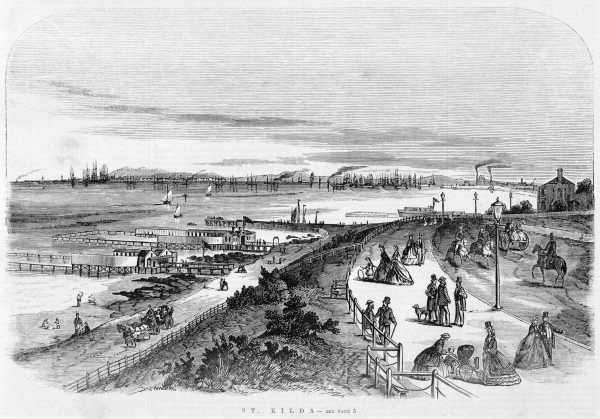
St Kilda in 1864, shortly after its founding.

So if the suburb is named after a boat, where then did this craft take it's name from?

The Lady of St Kilda was a schooner, built in Devon in 1834 for Acland and used by him as part of his trading business (initially bringing fruit from the Mediterranean to England). Acland named the ship after a visit his wife Lydia had paid the St Kilda archipelago, part of the Outer Hebrides Islands off the coast of Scotland, for a holiday in 1810.


Although the lady of the ship's name is not Lydia herself but Lady Grange, a famous prisoner once kept on Hirta, the main island of the St Kilda group.

Lady Grange was the wife of James Erskine, a wealthy 18th century Scottish lord and barrister. In 1732, the good lady discovered papers that showed her husband was involved in a plot to overthrow the British monarchy. The plot was part of an ultimately failed coup attempt designed to install Scottish heir Bonnie Prince Billy on the British throne. Outraged by this treasonous behaviour, Lady Grange immediately determined to reveal her husband's activities. But Erskine was alerted to his wife's maneuver and struck first.


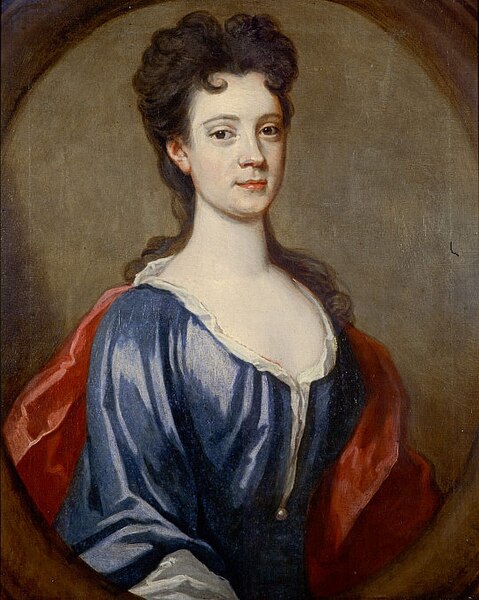
Rachael Chiesley, AKA Lady Grange

Lady Grange was abducted at her husband's order and taken initially to an isolated castle that he owned in northern Scotland. She was then interred in a private mental hospital before being moved to the St Kilda islands around 1735. Now imprisoned in one of the most isolated inhabited spots on Earth, the noblewoman endured years of degrading treatment; living alone in a stone dwelling with an earthen floor, among a small local population who spoke no English, suffering poor health due to the island's harsh climate and lifestyle.


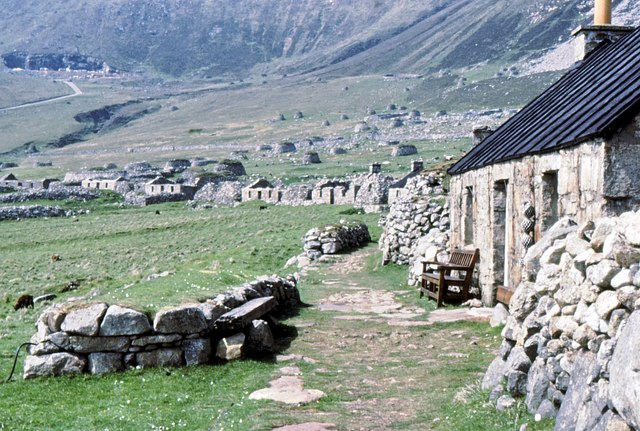
Barren, windswept, primitive; a village street on Hirta
She would remain on Hirta until about 1740, when she was finally able to smuggle a message to her supporters on the mainland begging for rescue. An armed rescue party was raised, but by the time it reached Hirta, Lady Grange had been removed and taken elsewhere. She died, still in her husbands captivity, in 1745.

Acland then, had had his attention brought to St Kilda by his wife's visit, and had named his ship as tribute to this long suffering British patriot.

But what of the islands themselves? Where did they take their name from? What is the root of the name 'St Kilda'?

While opinions differ, the most widely accepted theory has this as a simple translation error. The first settlers of the islands were Norse, and some histories show the name of the islands recorded as Skildir, an old Norse word meaning 'shield.' This has been mis-recorded on a Dutch map from 1583, which has the name as Skildar. These same charts were revised and updated by the Dutch Government in 1592, Skildar now being misrecorded as S.Kilda. This type of error was common at the time, due to human error and the primitive means available for recording printed information.

As the Dutch were among the foremost seafarers of this time period, and among the furthest travelled, many other countries would base their own official charts on those of the Dutch. British chart makers who used this 1592 map as the basis for their own work, simply assumed that S.Kilda was a shorthand way of recording St Kilda, and recorded it as such themselves.

And so a previously unrecorded Saint was summoned into existance, which 250 years later would find it's way into the name of one of Melbourne's beachside suburbs. The last of Hirta's population left the islands in 1930, the St Kilda islands are now a UNESCO listed World Heritage Site.


Wednesday, August 28, 2013

Nicholson Street: Then and Now


While researching another topic I came across this fantastic drawing of Nicholson Street, adjacent to the Exhibition Gardens, from 1864. The row of two tone terrace houses is still there, looking as spiffy as ever.


1864.


2013.