Running underground between the touristy restaurants of Degraves Street and the western entrance of Flinders Street Station is one of Melbourne's hidden treasures: the art deco style of the Degrave Street Subway. This short tunnel, perhaps thirty metres long, has an unusual story, encompassing both long delays in its planning and long years of neglect once built. Even its name is unusual. Officially, the underpass is called The Campbell Arcade, a name which Melbournians rarely apply to it.
 |
| The entrance to the subway; present day. |
When it was built in 1854, Flinders Street Station was not only Melbourne's first train station, but Australia's. Elaborately designed and sitting at the middle of a heavily used public transport network, the station was both an important piece of infrastructure and an architectural ornament to the city. From the first, it was one of Melbourne's most iconic buildings, and one of its most utilised.
By the 1920's, daily patronage at the station passed an average of 250 000 passengers, making it one of the busiest railway stations in the world.
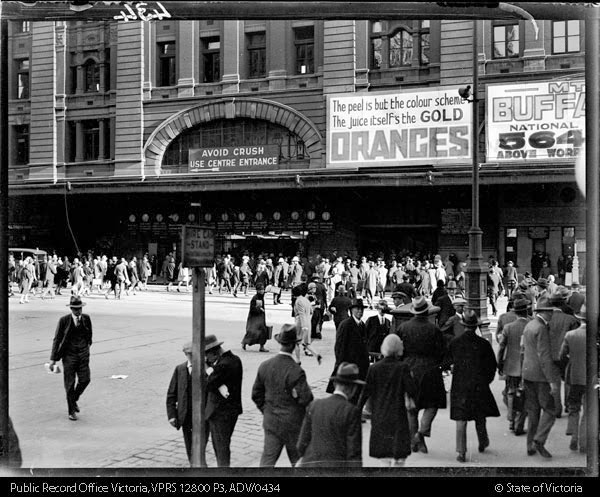 |
| Elizabeth Street entrance in the 1920' s. Use the centre entrance to avoid the crush! |
To alleviate these problems, the council considered several plans including a pedestrian bridge (or even bridges) over Flinders Street. Finally, however, they settled on an underpass, thinking they could incorporate some retail space into the design and so offset some of the cost. Almost directly opposite the western station entrance, and a busy pedestrian thoroughfare in its own right, the end of Degraves Street was settled on as the location.
But almost immediately, the council ran into difficulties.
 |
| Local newspaper article outlining the planning problems for the subway, May 1928. |
Melbourne City Council had to deal with a number of stakeholders - State Rail, the State Government, private owners of the land - as it tried to implement its subway plan and reaching consensus with them all proved difficult. Budgeting for the costs of the project - estimates varied widely - and then raising the funds also proved to be difficult. And finally, the installation of automated traffic control signals on Flinders Street, the city's first, helped to reduce some of the problems that the subway plan was meant to solve:
 |
| The Argus, May 1929. |
But subway planning work continued haphazardly through to the end of the 1920's, before being derailed by the Great Depression and then World War 2.
After the war, the Council would return to the plan in earnest, as part of a wider ranging programme of works designed to modernise the look and utility of the city. Two factors drove the modernisation programme: the announcement that Melbourne would host the Olympic games in 1956, and the hard charging head of the Public Works department, Robert Burns Campbell.
 |
| Robert Burns Campbell |
Campbell was a Collins Street dentist who had been elected to the City Council in 1944. After the war, he had devoted an increasing amount of his time to public office and left his practice to take over the Public Works department in the early 50's. He oversaw, and helped drive, a controversial programme of works that would transform large parts of the city (including the demolition of a number of prominent heritage buildings).
One of the projects championed by Campbell was the Degraves subway.
 |
| Construction finally underway, February 1953. |
While the issues facing the project were much the same as they had ever been, Campbell's forceful personality and dedicated approach finally forced progress. Construction on the subway started late in 1952 and was completed early in 1954. Although Campbell only just lived to see the subway's completion, as he died suddenly in June 1954, aged only 65. As a mark of respect to this hard working, although not always kindly regarded, man, the new subway was renamed in his honour: The Campbell Arcade.
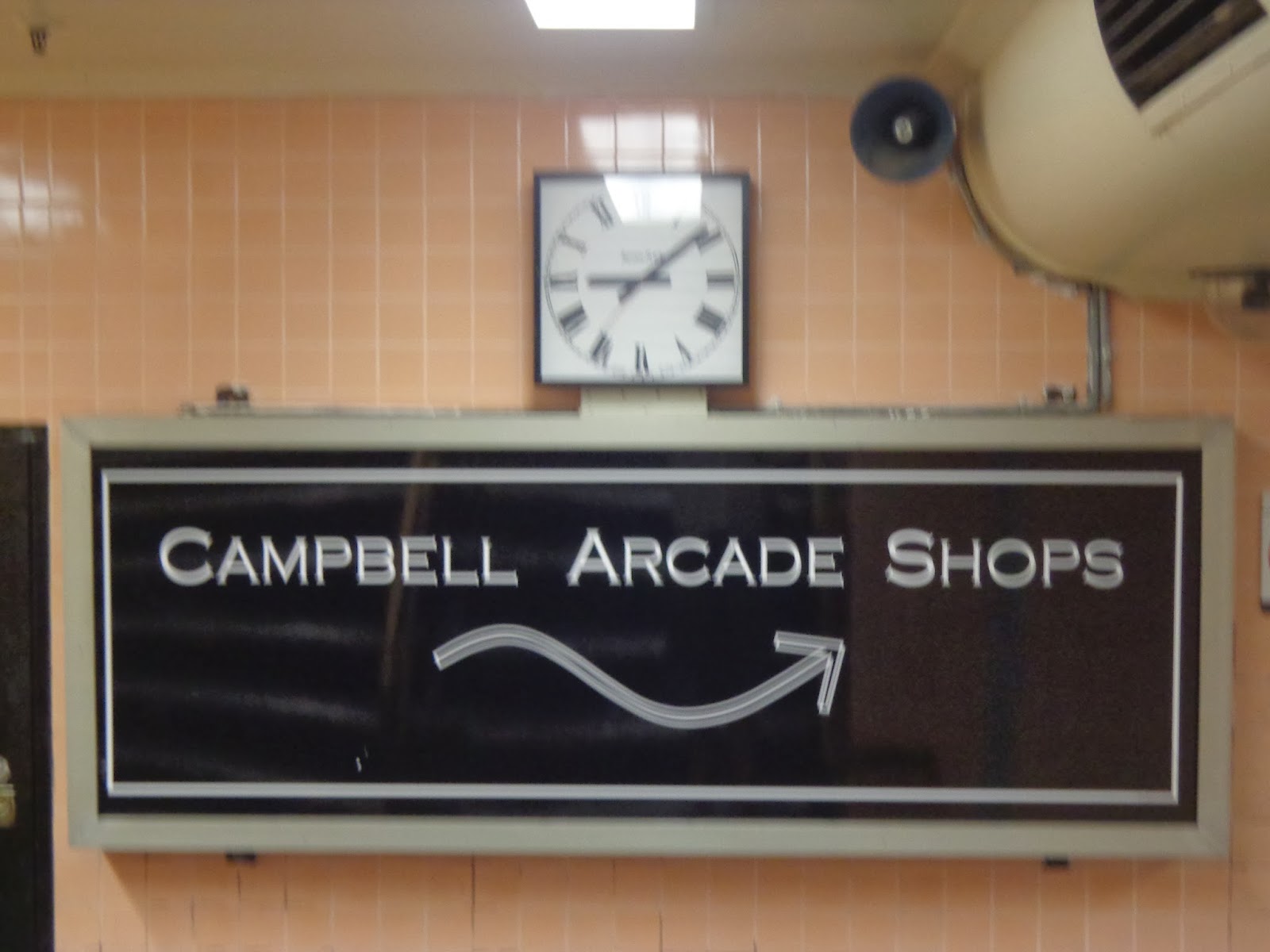
Finally completed after decades of delays, the arcade/subway opened to positive reviews. The subway's interior sported a highly stylised, art deco design featuring black granite columns and soft pink, mosaic tiles. And the boutique retail space - shops with appealing curved windows and wooden fixtures - were highly sought after; Melbourne City Council received more than a thousand applications for the half dozen available spaces.
Adding to the appeal of the arcade was another unique feature; at the base of the stairway entrance from Degraves Street was an underground entrance to the Mutual Store, one of Melbourne's largest department stores. Founded in 1872, The Mutual Store had been razed by fire but rebuilt in grand fashion in 1891.
 |
| The mutual store in its original incarnation. |
 |
| The Mutual Store building is now used for apartments. |
The subway seemed likely to become an immediate, thriving fixture in the heart of the city.


 |
| Images of the subway, shortly after completion. |
But there was a problem.... no one used it.
During the planning stages, the city council had estimated that 20 000 pedestrians would use the subway each day. This was based on measured commuter usage of Flinders Street Station and studies that had been conducted on foot traffic along Flinders and Degraves Streets. This expected high volume was what finally allowed all of the planning issues to be overcome, and also explained business enthusiasm for the commercial spaces.
 |
| Spiffy, but hardly used; circa 1960. |
But after some initial excitement once the subway opened, nothing like these numbers materialised. Estimates made in 1956, barely two years after the opening, showed that only about 2 000 people per day were using the subway. And a public study conducted by the council showed that 2 out of 3 people surveyed were unaware that the subway even existed.
Businesses that had signed up for the shops, and who had paid a hefty premium for the privelage, suddenly found themselves in a very awkward position. Without the high volume of passersby that had been expected, their ventures became unprofitable.
One proprietor, selling women's clothing, even tried holding a fashion parade in the subway to drum up some business... at least until the rail authorities forced him to stop.

While lower rents were eventually negotiated, most businesses found the subway too difficult a space to generate revenue. Adding to the gloomy outlook, The Mutual Store closed in 1965 and the nifty underground entrance was closed off.
 |
| A faint trace of a sign for The Mutual Store entrance remains. |
While businesses that did make a go of it were in product lines less grand than had been originally envisioned:
 |
| Long running subway milk bar, now defunct. |
Another difficulty was that the subway, like Flinders Street more generally at the time, was prone to flooding. Serious floods like the one in 1972 saw the subway completely underwater, but even just heavy rain would cause water to accumulate on the floor. At times, rail workers were even enlisted to help subway pedestrians shuttle back and forth:
 |
| A minor flood in 1965. |
The result of these various problems was that the subway never really took root. Businesses that tried their luck were generally transitory and the majority of the shops stood vacant for extended periods. Pedestrian numbers also never really increased. Throughout the 70's and 80's, the Degraves subway was a neglected white elephant, used by homeless people as a place to sleep and by blokes looking for a quiet place for a slash.
But fortunately, this story has a positive ending.
In the 1990's, the city council decided to take an interest in their creation again and funds were allocated to clean up the subway. Some creative re-imaging of its space also took place.
The Platform Contemporary Art Group, with funding from both the council and the State Government, took over the old display cases that line one wall of the subway and turned them into a small gallery space. Since 1993, these cases have been filled with an ever changing array of public modern art projects:

 |
| Contemporary art in the subway. |
In a similar vein, the shops that dot the subway are now home to an entirely different set of tenants. Second hand clothing. deluxe coffee and hand made 'zines are now on offer at shops with hip names like Corky St Clair, The Sticky Institute and The Cat's Meow.

 |
| Contemporary subway retailers. |
The fashionable young punters that frequent these shops are light years removed the working middle class that the council undoubtedly imagined the subway would serve. But the resurgence of the space proves that their decision to build the subway all those years ago was the right one, even if it proved to be for very different reasons.


