Showing posts with label Mystery. Show all posts

Wednesday, May 27, 2015

The Weeping Woman Goes Missing

In 1937, Spanish artist Pablo Picasso completed one of the great artworks of the 20th century; Guernica, his epic take on the horrors of war. Inspired by the bombing of the town of Guernica in the Spanish Civil War, this dramatic piece represented one of Picasso's few forays into political commentary, and created a storm of controversy when it was first unveiled.

Guernica, The National Museum of 20th Century Art, Madrid.

The painting itself presents a variety of riffs on the theme of suffering; bodies are dismembered, a cavalry horse screams, debris and refuse are strewn chaotically. Three and a half metres tall, more than seven metres wide, and deliberately provocative, Guernica provides a disturbing vision of some of the worst excesses of human behaviour.

While Picasso worked on this piece he was shadowed by Dora Marr, a young photographer who was documenting his technique and method. The two became lovers and Marr later served as a model for a series of paintings often viewed as companion pieces to Guernica, the Weeping Woman series.

Photographer Dora Marr.


Weeping Woman, Tate Modern, London.

Completed later in 1937, The Weeping Woman pictures again offer a depiction of suffering, although this time set in the everyday. Picasso hoped that the more intimate setting would provide a more universal image, allowing an easier connection for the audience than the more extreme imagery of Guernica.

The painting shown above is the last in the series, with the different canvasses finding their way into different collections around the world. In 1985 one of these, formerly owned by Picasso's daughter, was acquired by the National Gallery of Victoria (NGV).


The Weeping Woman, NGV, Melbourne.

With a price tag of $1.6 million, this Weeping Woman was, at that time, the most expensive artwork in a public collection in Australia. NGV Director Patrick McCaughey was well pleased with his pricey coup, declaring that the portrait would 'haunt Melbourne for the next hundred years.'

On, or around, August 4, 1986, the painting was stolen.


But little did McCaughey know, that in a way the painting had been removed to the ACT.

That same morning, 'The Age' newspaper received a letter from unknown persons, claiming responsibility for the theft. Calling themselves the Australian Cultural Terrorists (ACT), the thieves also issued an eccentric set of demands, including an increase in Government funding for the arts, and the establishment of an annual prize for young artists. The thieves threatened to destroy the painting if their demands were not met.


Patrick McCaughey

McCaughey fronted a press conference in the afternoon to break the news to the wider public and appeal for the paintings safe return. 'If the picture is ruined or damaged in any way, this gallery will never be able to afford another Picasso,' he solemnly declared.

The police investigation of the theft then began in earnest. Investigators theorised that the thieves may have hidden in the gallery overnight, removing the painting from its frame and placing the registrars card while the building was empty. Then, in the morning, they could have simply walked out; the NGV's Weeping Woman measured only 55 x 47 centimetres, so could easily have been concealed in a bag or under a coat.

The NGV's moat was drained, the building searched and the staff questioned, but clues were scarce. The only real leads were the ransom letters, two more of which arrived in the week following the theft; these new letters mocked the police and McCaughey, but saved its most vitriolic comments for State Arts Minister Race Matthews, who was referred to as a 'mouldy bag of gas.'

Picasso Theft, by Juan Davila.

The arts community's response  was mixed.

Many artists publicly decried the theft, while a smaller number recognised merit in the ACT's demands for increased arts funding. Chilean painter Juan Davila painted a picture inspired by the crime, Picasso Theft, which he offered as a replacement to the NGV (this artwork was itself stolen from a small gallery in Sydney), while a private gallery in Adelaide curated a show of copies of Weeping Woman, all created by local artists.

Meanwhile, the official investigation went nowhere.


Two days later, a telephone call was received by 'The Age' from someone who identified themselves as a member of the ACT. They advised that the Weeping Woman could be found in locker 227 at Southern Cross station.

Police, television crews, and one very harassed art gallery director descended on the station. A custodian jimmied the locker open with a crowbar, and the painting was found inside, wrapped in brown paper. A relieved McCaughey told the press, 'It will go behind bullet proof glass this time, and be bolted to the wall!'

'The Age' reports the recovery, August 20 1986.

So who stole the painting?

McCaughey's story has caused many to point the finger at Mark Howson, but the gallery director himself did not think this likely. Howson had no criminal record, and was not known to be associated with any radical groups. At most, McCaughey thought Howson may have known the thieves and so passed on a message that the authorities were closing in. Or, McCaughey's meeting with the artist, and the paintings subsequent return, may have been a simple coincidence.

But whatever the truth of this part of the story, no one has ever been charged with the theft.

An official enquiry into the incident turned up no new evidence, and so could draw few conclusions. It's report was released to little fanfare at the end of August, after which the police abandoned their investigation altogether. With the artwork returned safely, all enthusiasm for any further pursuit of the thieves disappeared,

'I was thoroughly sick of the whole thing,' said McCaughey,

The theft did turn the spotlight onto the NGV's rather lax security, and some measures were taken to tighten these up. Among the changes, the chairs used by the gallery guards were removed on the orders of McCaughey, who decreed that these staff members were now expected to walk around the galleries while on duty, and so keep a more watchful eye on the gallery's visitors.

Deprived of their chairs, the guards went on strike.

Sunday, January 18, 2015

Melbourne's Pink Lake


Sitting directly below the Westgate Bridge, Westgate Park is a pleasant stretch of undulating grassland wedged between Port Melbourne and Fisherman's Bend, a short walk form the city.

The site has an interesting history.

In the 1930s it was owned by the Federal Government, and was home to the Department of Aircraft Production. The extensive facilities were used to design and build new aircraft designs, which were then tested on the site's own runway.

An aerial photo of the Westgate runway.

But the development of jet aircraft after World War II meant the runway became inadequate, and the department was moved to a larger property near Lara.

The vacant site was then used for a variety of public and private activities, including; motor racing, sand mining and waste disposal. The nature of these activities had a negative impact on the land, which became environmentally degraded.

The park under construction.
In the 1980s, the State Government decided to clean up the site, and set aside 54 hectares as a public park. It was opened in 1984, and dedicated as part of Victoria's 150th anniversary celebrations.

And the park is a welcome addition to a largely industrial part of the city. It sports a number of gentle walks, is home to a variety of bird life and even has a pedestrian punt, that crosses the Yarra on the weekends.

It also has three man made lakes, one of which turns bright pink in the summer time.


The striking colour is caused by a simple, but still quite rare, chemical reaction.

This is the park's salt water lake (the other major one is filled with fresh water) and the higher temperatures in summer cause some of the lake's water to evaporate, increasing the salt concentration. This then reacts with a single cell alga that exists in the lake, which produces the red pigment.

This interaction is only found in a small number of lakes around the world.


Monday, December 15, 2014

The Prime Minister Disappears


Sunday, 17 December, 1967: The lead in to Christmas was dramatically interrupted by some of the most sensational news in the history of the country; The Prime Minister, Harold Holt, had disappeared! 

The Sun reports the incredible news.

Initial details were sketchy.

Holt had gone missing while swimming in the ocean near Portsea and was presumed dead, although a search was ongoing. Exactly why Holt had chosen to swim off such rough coast, notorious for rips and unpredictable swell, was uncertain.

But Holt's chances of surviving long in the Southern Ocean were obvious to everyone.


Young man in a hurry: Harold Holt circa 1930.

Born in Sydney in 1908 to a family of modest means, Harold Holt distinguished himself from a young age as a scholar and sportsman. He attended Wesley College in Melbourne and his results won him a scholarship to the University of Melbourne, where he studied law and captained the school cricket and football teams, as well as starring on the debate team.

He was a popular student, but was also viewed as a ruthless, ambitious young man. His driven nature has often been attributed to his parents; his mother died when Harold was 8 and his father was an aloof and remote figure, devoted to his business interests.

After graduating, Holt passed the Victorian bar in 1932 and went to work as a barrister in Melbourne. He also joined the United Australia Party (UAP), the leading conservative party in Australia at the time. His education and skill as a debater made him an obvious choice as a candidate for elected office, and he ran unsuccessfully in the Federal election of 1934 and state election of 1935.

Despite these setbacks, the UAP viewed Holt as one of their rising stars and offered the young go-getter the safe seat of Fawkner. Elected to Federal Parliament at the age of 27, Harold Holt remains one of Australia's youngest MP's. His intellectual accomplishments were backed by a debonair appearance and manner; handsome, genial and immaculately dressed, Holt cut quite a public figure in the staid 1930s.


Holt poses for a magazine article.

Joining the UAP in the same year as Holt, but 14 years his senior, was another man destined for the top of Australian politics; Robert Menzies. Menzies and Holt were dissimilar in many respects, but had similar policy ideas, and shared a strong work ethic and love of the theatre. They became firm friends, in and out of politics.

With the shock death of Prime Minister Joseph Lyons in 1939, Menzies (made deputy leader only the year before) assumed the Prime Minstership in dramatic circumstances. A bellicose man, not always easy to work with, Menzies reshuffled cabinet to reward his close colleagues within the party, continuing Holt's rapid rise by promoting him to the Ministry.


Robert Menzies, late 1930s.

But Menzies' blustering style made enemies within the UAP as well, and he was forced to resign in 1941 after a vote of no confidence. Surprisingly, Holt was one of the members who voted against Menzies, although he never revealed his reason and the two would remain friends.

Ongoing tensions within the UAP  would lead the party to splinter and then, finally, to dissolve, in 1944. In the space this created on the Conservative side of politics, Menzies formed a new party, The Liberal Party, as a vehicle to bring him back to power. Holt was one of the first members of the new enterprise, joining the Prahran branch.

When Menzies was re-elected in  1949, Holt was one of the highest profile members of his cabinet, and was already being touted as a future leader. Over the next decade, Holt would serve in a variety of positions, including  Minister for Labour, Immigration and National Service. In 1958 he succeeded Arthur Fadden as Treasurer, the traditional role for the heir apparent.

But he had a long wait. Menzies did not retire until 1966, with Holt sworn in as the 26th Prime Minster on Australia Day of that year. Menzies declared the country 'in good hands.'


Official portrait of Harold Holt, PM.

As Prime Minster, Holt largely continued with the policies of the Menzies era, although he modulated the details of some. Menzies signature 'White Australia Policy' was kept, but the restrictions on non European immigration were relaxed. 

But Holt is best remembered for his personal friendship with American President Lyndon Johnson, and his resulting decision to escalate Australia's involvement in the Vietnam war.


Holt and Johsnon.

The two men were known to each other before Holt became Prime Minister, but they became close when Holt visited Washington in July 1966. They shared a similar background and temperament and became so close that Holt's wife would describe their relationship as 'spectacular.' This visit to the US was when Holt made his famous remark 'all the way with LBJ,' in regards to US-Australian relations.

Johnson's return visit to Australia in October 1966 was less cordial, with violent demonstrations dogging the President's itinerary. Although the prestige attached to the visit - Johnson was the first US President to visit Australia - also had a positive effect. For despite the unpopularity of the war in Vietnam, Holt secure a crushing victory at the 1966 election. The Liberal Party result at the poll - 56.9% of the two party vote - is the highest recorded in Australian history.

Holt ended 1966 with control of both houses of Parliament, and firm control of his party, seemingly at the height of his powers.


On December 17, 1967, Holt rose early and drove down to Mornington Penninsula to watch solo around the world yachtsman Alec Rose enter Port Phillip Bay. With the Prime Minister were some friends, and two bodyguards, and after Rose had sailed by, the small party made their way to Cheviot Beach for lunch.

It was a broiling day and, always a keen swimmer,  Holt decided to take a dip after lunch.

His friends tried to dissuade him. The surf was rough and Holt's health - he had collapsed in Parliament earlier in the year - had been in doubt.

But the Prime Minster was determined. He had a holiday house nearby and knew the area, and the ocean conditions, well. He dismissed concerns about the rough sea and changed into his bathing suit, before striding into the ocean.

He quickly swam out past the breakers.


Other witnesses said they had seen Holt turn around and make for shore, before disappearing below the waves.

The alarm was immediately raised.

Within an  hour helicopters were scouring the waves, and by sunset more than 200 search personnel were on site. The largest search - at that time - in Australia's history would last for three weeks and involve members of the Army, Navy and Coast Guard. But after two fruitless days, those involved knew that the best they could hope for was to find the PMs body.

Holt was pronounced dead on December 19 and National Party leader John McEwan was sworn in as Prime Minister the same day. On December 22 a memorial service was held for Holt, attended by 19 heads of state from around the world, Holt's good friend Lyndon Johnson among them.

No trace of Holt's body has ever been found.


And there the matter might have rested.

But the absence of a body, and the unusual circumstances surrounding the disappearance, caused some alternative theories to come forth.

In 1970, paranormal investigator John Keel wrote Operation Trojan Horse, a widely read book that claimed that aliens were behind a number of unsolved mysteries from history. Keel claimed that Holt had, in fact, been abducted by aliens; just the latest example of their regular intervention in human affairs. 

And in 1983, British journalist Anthony Grey wrote a best selling book that claimed Holt was actually a spy, working for the People's Republic of China. In this telling, Holt hadn't drowned but had actually learned that his cover was about to be blown, and arranged to be collected by a Chinese submarine.

Still other theories posited that Holt had been assassinated by the CIA - who had learnt of his intention to withdraw Australian troops from Vietnam - or that he had simply become depressed and committed suicide. 


Cheviot Beach, present day.

In 2005 the Victorian Coroner, who had not previously investigated due to the absence of a body, conducted a formal inquiry. Their conclusion was that Holt had accidentally drowned; a tragic case of an experienced swimmer overwhelmed by freak conditions. The report speculated that Holt's body may have been swept from the area by strong currents before it could be found, or eaten by sharks, both common enough in the Southern Ocean.

Holt remains the only Australian PM to die of unnatural causes while in office.


References

http://en.wikipedia.org/wiki/Harold_Holt

http://adb.anu.edu.au/biography/holt-harold-edward-10530

http://en.wikipedia.org/wiki/Robert_Menzies

http://www.aph.gov.au/About_Parliament/Parliamentary_Departments/Parliamentary_Library/pubs/rp/rp1112/12rp06/12rp06l

http://www.abc.net.au/gnt/history/Transcripts/s951005.htm

http://www.smithsonianmag.com/history/the-prime-minister-who-disappeared-15319213/?no-ist

Thursday, December 12, 2013

The Westall UFO

Clayton South, south east of Melbourne, is an average middle class suburb a short distance from the CBD. Established in 1929 as the city expanded south, the Clayton area today is the very picture of modest, well kept ordinariness.

There are houses and apartment buildings, and a number of schools and parks. One of Melbourne;s best universities, Monash, is a short distance away, as is one of Australia's best golf courses, in Kingston Heath.

But Clayton South has as extraordinary footnote in the history of our city; it is also the site of Australia's largest mass UFO Sighting.

The renamed Westall Secondary College, present day.

Clayton South: 'A' marks the spot of the secondary school.

April 6, 1966 seemed a typical autumn day for the teachers and students heading into the two local schools; Westall High and Westall State school, the adjacent primary. Nothing seemed out of the ordinary, it was just a day like any other.

Around 11.00am, a class of students at the high school were playing a game of cricket on the sports oval. Other children milled around at the end of their morning break, watching the game or just mucking about.

All of a sudden, out of nowhere, something unusual appeared in the sky. An object, a silver-grey disk or saucer, moving slowly over the school, heading south.

The shock caused by the saucer's appearance was immediate: panic! Some of the children shrieked, while several threw themselves to the ground in fright:


The commotion drew more students and teachers, who ran outside to see what was happening. As many as 100 witnesses at Westall High have been identified as indicating they saw something in the sky that day, although their testimony varies.

Andrew Green, a science teacher, said he saw a silvery-green disk, about twice the size of a family car.

Joy Clarke, a second form student, said she saw 'three flying saucers.'

Some witnesses reported hearing engine noise coming from the object, or that they saw a light aircraft pursuing it.

Others have refuted these claims.


An artists impression of the incident.

The object's trajectory took it over the high school and then over the neighbouring primary, where its appearance again caused pandemonium. Children in both schools ran around chatoically; crying, yelling, pointing at the sky:


Next to the primary school was an open patch of vacant, overgrown land, called Grange Reserve. The object lost height once it was over the reserve and was witnessed descending behind a stand of trees. A number of excited students made to pursue the craft, some by climbing the school fence.

But after a short pause, probably no more than a couple of minutes, the object ascended from the trees again and departed the area, heading north west. It was soon lost from view, never to be seen again.

Witnesses who made it into the Grange shortly after the object's final disappearance reported seeing a flattened circle on the ground.


Artists impression of what was found in The Grange reserve.

Back at the high school, in the immediate aftermath, an attitude of secrecy was adopted. High school Principal Frank Samblebe called an assembly and told his stunned students:


Other witnesses claimed to have seen RAAF personal and government vehicles in the area around he Grange Reserve, immediately after the sighting.

The press coverage the following day was mixed. The local newspaper, The Dandenong Journal, made the 'Flying Saucer Mystery' its front page:


While The Age  ran a smaller, considerably more measured, item in it's local news section:


And this second story has probably become accepted as the official version of events.

The Government, state and federal, has always denied that they had any planes in the area at the time, and also that no military personnel attended the site to investigate. Diligent checking of the public record by private investigators has also failed to uncover any official reports or documents relating to the Westall event.

The absence of any official explanation, along with the now hazy memories of the people involved, has allowed a fine conspiracy network to spring up around the Westall incident.

It has a global profile as one of the world's most well known UFO events, and is one of the few to feature a large number of credible witnesses. In recent years, local interest in 'Australia's Roswell', has flickered from time to time as well:


In 2010, researcher Shane Ryan presented a documentary - Westall '66 - about his investigation of the incident, based on exhaustive research over a five year period. Through a public appeal, Ryan was able to uncover many previously unknown witnesses to the event and many from the surrounding area beyond the school grounds. In an interview given to the The Age in 2010, Ryan expressed his certainty that all those witnesses had seen... something:


But Ryan was unable to reach any solid conclusions about what had happened. He was frustrated, he said, by a lack of cooperation from official sources. In the interview excerpted above, Ryan states that his belief is that it was a Government aircraft of some sort, but that proof was scarce.

And in this, he mirrors the frustration of the people who witnessed this unusual event. People who, even after nearly 50 years, still aren't exactly sure what they saw that day.

To mark the anniversary of the event in 2004, The Westall UFO was given a small commemoration by the local council, when they named their new adventure playground in its honour.


Saturday, June 1, 2013

The Princess Theatre Ghost


March 3, 1888: A production of the opera Faust opens at the Princess Theatre in Melbourne, with tenor Federici playing the Devil, Mephistopheles. At the dramatic conclusion to the piece, Federici is lowered through a trapdoor in the floor, symbolising his decent to hell, accompanied by thunderous applause from the sold out house. As he is lowered into the cellar, the actor suffers a heart attack and dies shortly thereafter. The Princess Theatre Ghost is born.


Federici

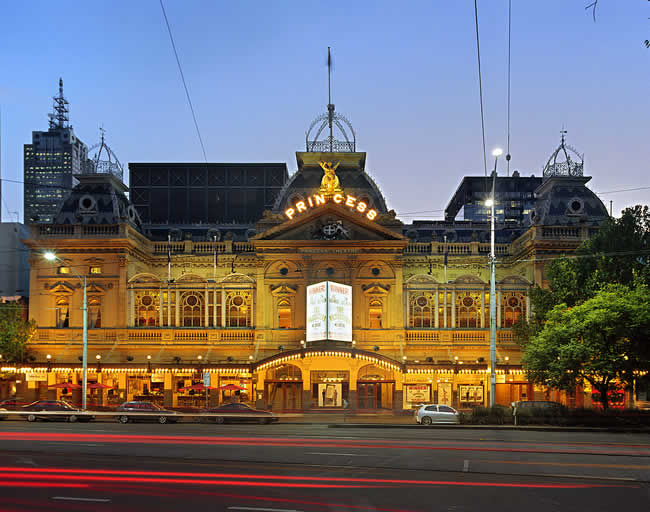
The Princess Theatre on Spring Street is one of Melbourne's most iconic buildings. It was built in 1854 and then extensively renovated in 1885-6 to the design of famed local architect William Pitt. When completed, the remodeled theatre featured an elaborate facade, electric lighting and a retractable, domed roof.


The redesigned Princess Theatre, in a
sketch by the architect, William Pitt.

The theatre as it appears today.

The Princess opened with a performance of Gilbert and Sullivan's The Mikado in 1886. Among the cast was Federici.

Federici, born Frederick Baker, had Italian heritage but had grown up in London. He had been a trainee diplomat before he turned to the stage in his early twenties. Federici found success as a bass tenor and  performed around the world (he played the lead in The Mikado on Broadway) as well as in a number of local productions.

But it was the dramatic events of March 1888 that would immortalise his name in the history of the Australian stage:


More drama ensued when Federici was buried the following week. The attending priest dramatically fainted during the service, which then had to be completed by one of the pallbearers. Federici's grave is located in Melbourne's General Cemetery:


There is no clear evidence to indicate when the sightings of Federici's ghost began (some stories indicate they began the night Federici died, when he was seen taking his bows on stage, but this appears apocryphal), but they have become legion as the years have passed. Some witnesses report seeing a well dressed man seated in the dress circle, or on stage, while some report less well defined mysterious lights, or the sensation of something invisible touching them, or brushing passed them in the corridors.


Federici's ghost has such renown that Princess Theatre management have taken to leaving a seat vacant in the Dress Circle when new productions start, in case he wishes to attend. Some have described him as the most famous theatre ghost in the world.

Thursday, November 22, 2012

The Disappearance of Frederick Valentich


When Frederick Valentich took off from Moorabin Airport on the evening of October 21, 1978, his objective seemed simple.

His destination, Kings Island in Bass Strait, was only a 90 minute flight away. The round trip should only have taken a few hours.

While Bass Strait had a reputation for treacherous flying conditions, the weather on the 21st was clear. Valentich, while only 20 years old, had already logged significant flight time and was considered a capable young pilot.

He had planned the quick hop to the island to pick up some friends and some fresh seafood, to return with both to a family reunion later that evening.

Little did anyone know, that Valentich was about to fly into local history.

About forty five minutes into his trip, Valentich reported to Melbourne Air Traffic Control that he was being pursued by another aircraft.

Moving at high speed, the unidentified object quickly overtook Valentich's Cesna, and returned to buzz him several times. Shortly after 7 o'clock, Valentich reported that the other was flying directly towards him... after which all contact with Valentich's plane was lost.

No trace of him, or his aircraft, has ever been found.

Frederick Valentich with a Cessna, similar to the one he disappeared in.

Frederick Valentich had always wanted to be a pilot. It was all he had ever expressed an interest in doing.

He was so enthusiastic that he started flying lessons as a teenager, as soon as he was legally able, and by the time he was 18 he had already obtained his pilots license.

Valentich would take flights from Moorabin Airport, using an old RAAF training plane, as he built up his experience. Longer term, his goal was to either join the Air Force, or become a commercial airline pilot.

By October 1978, Valentich had attained a Class 4 instrument rating, significant for someone his age, and had 150 hours of flight time behind him.

King Island, in Bass Strait

Rugged, windswept and scenic, King Island is an isolated spec in Bass Strait, halfway between mainland Australia and Tasmania. Originally settled by whalers and sealers, by the 1970s the Island was well known for its high end agricultural produce, primarily beef and cheese.

On October 21 Valentich filed a flight plan with Moorabin Airport advising of his trip to the island.
Oddly, he did not inform King Island Airport of his trip, and the lights at the small airfield were not turned on.

The 235 kilometre round trip was expected to take about three hours.

Valentich took off in a Cessna 182L at 6.19 pm, and headed south.

At 7.00 pm he radioed back to Melbourne Air Traffic Control as he flew over Cape Otway, on Victoria's south coast, and reported nothing out of the ordinary; winds were light, visibility good.

Steve Robey, Melbourne Air Traffic Control

At 7.06 pm, Valentich radioed Melbourne to ask if there were any other aircraft in his vicinity.

Told that there weren't, Valentich reported that a large aircraft had just flown over him, about a thousand feet above his own plane.

Flight Officer Steve Robey, on duty at Melbourne Air Traffic Control, asked Valentich to identify the aircraft and the pilot told him this was difficult, due to the other plane's high velocity. But he stated that it looked metallic and had four bright lights on it, like landing lights.

Valentich then told Robey that the other plane had circled above him for a few moments, 'orbiting' as the pilot put it, before vanishing.

Panel from a graphic novel of the incident, by Emi Gennis

At 7.09 pm, Valentich contacted again to report that the unknown plane had returned and was approaching him at high speed from the South East. He added that he thought the other pilot was 'playing a game' with him.

Asked again by Robey to identify the other craft, Valentich was still vague, although he added that it had a 'long shape,' that its lights were green and that its exterior was 'shiny.'

One minute later, Valentich reported another fly over by the craft, this time from the South West.

At 7.11 pm, he also indicated that his own plane was showing some signs of mechanical difficulty; that the engine was 'rough idling.'

Asked his intentions by Robey, Valentich confirmed that he was going to push on for King Island. At this time, he should have only been about twenty minutes flying time from his destination.

At 7.12 pm, only six minutes after he had first reported the other mysterious craft, Valentich sent his final message:


This was followed by 19 seconds of static and white noise.

And then all contact was lost.

The local press reports the story.

Unable to communicate with Valentich, Robey raised the alarm and a Search and Rescue order was issued.

Two RAAF transport planes were dispatched to search for Valentich's plane, although the advanced hour and poor visibility meant that not much was done on the first evening.

The unusual nature of the incident, and the pilot's own description of encountering a mysterious craft immediately before disappearing, meant that the story would be headline news the following day.

Official investigation summary.

The search continued for four subsequent days, but no wreckage or any other physical evidence would be found. A small oil slick was spotted on the sea's surface just near the Cape Otway lighthouse, where Valentich radioed shortly before his strange encounter began, but a subsequent analysis showed the oil was not aviation fuel and this clue was abandoned.

After two weeks, the Victorian Department of Transport would conclude that the cause of Valentich's disappearance was 'unknown,' although it was presumed to be fatal for the young man.

And there ended the official investigation.

So what happened to Frederick Valentich?

Guido Valentich with a photo of his son.

The most likely explanation is that the Valentich crashed his plane.

While it was considered unusual that no wreckage was found during the search, this was not thought of as conclusive evidence that he had not crashed into the ocean. The difficulty of any search at sea, combined with the rough nature of the water in Bass Strait, may have caused the wreckage to sink or disperse in such a way to leave no trace.

Another difficulty for the search and rescue teams was that Valentich's Cessna was small enough that it did not show up on Melbourne Air Traffic's radar. So there was no way of verifying exactly where Valentich was prior to losing radio contact.

The search parameters were based around where Valentich said he was before he disappeared, and nothing more. He could have been mistaken and so inadvertently sent the search party off in the wrong direction.

Some aviation experts have also speculated that the young pilot could have become confused or disorientated, attempting such a long flight on his own. He may have even seen his own plane's lights reflected in the ocean and mistaken them for another aircraft.

But the lack of evidence meant the field was open for other theories.


Instead of accidentally mis-reporting his location, some commentators floated the idea that Valentich could have deliberately mislead Air Traffic Control and used this as a cover to disappear.

At the time of the incident, Valentich's Cessna would have had enough fuel to fly another 800 km, more than enough to get him out of the vicinity of the subsequent search. He could very well have never been in the vicinity of Cape Otway, at all.

But why would he want to fake his own disappearance? Valentich was described as an amiable young man, with no obvious reason for running away. And no evidence has ever surfaced to suggest that he landed his plane anywhere else in Victoria.

So if he didn't crash, and he didn't fake his own death, could he have been abducted by UFOs?

One of the photos taken by Roy Manifold

On the evening of October 21, Melbourne plumber Roy Manifold was driving along the south coast when he stopped to take some photos of the sunset.

At around 6.45pm, by his estimation, he claims to have seen a large object emerge from the water, several hundred metres off shore, and then fly away at high speed, quickly disappearing from sight.
Manifold was able to snap some photos of this event, although they are blurry and inconclusive (the best known of these is produced, above).

Other witnesses also came forward to say that they had seen unusual lights in the sky over Bass Strait that night.

Barham Valley Rd, where an unidentified witness claimed to see lights.

A local man and his two young nieces, never publicly identified, later reported to UFO investigators that they had seen lights near Apollo Bay.

Driving home along Barham Valley Road, after a rabbit shooting trip at dusk, these witnesses claim to have seen a set of lights, like those of a small plane, with a second green light hovering above.

The man thought the sight remarkable enough that he pulled his car over so he could watch the lights more carefully. The lights were moving from right to left, with a downward trajectory, and it took about 90 seconds before they disappeared from view behind the treeline.


The Manifold photos, and the Valentich case more generally, have become a favourite of UFO and paranormal investigators worldwide.

A quick google search will return any number of hits on either subject, and a wealth of 'evidence' beyond the points I have listed here.

All of which leaves us pretty much where we started.

A young man with a love of flying disappears during a short, routine flight, leaving no physical evidence. He also leaves a recording of a strange, eerie radio conversation, where he claims he is being pursued by a UFO, immediately before he vanishes.

While we may never know what happened to Frederick Valentich, we can also never be sure that there isn't some additional evidence out there, at the bottom of the ocean or somewhere else, waiting to be uncovered...